Android app
HiraKataQuest
Most kana apps stop at recognition. This one makes you write each character by hand and tells you how well you wrote it.
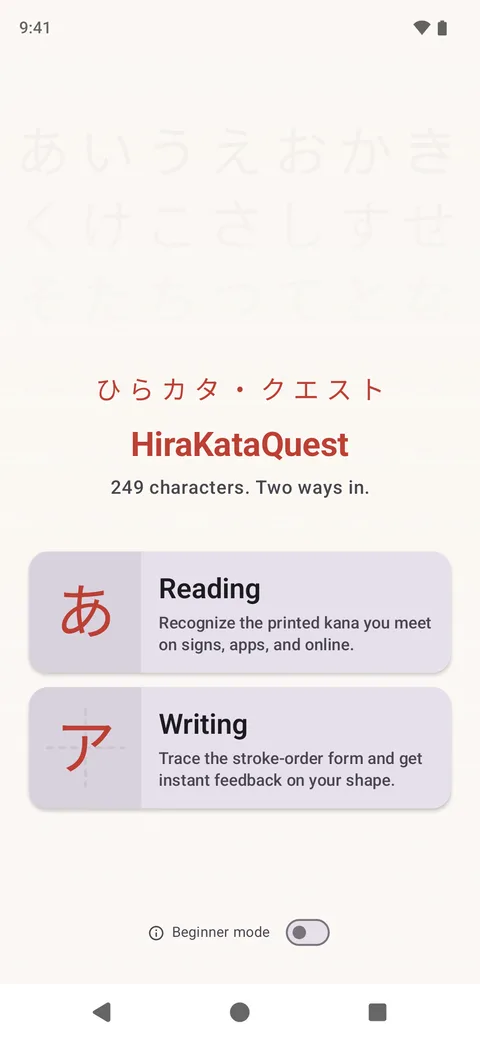
Reading and writing
Both tracks work on single characters and on whole words, in hiragana and katakana. In a word, every kana is scored on its own.
Reading
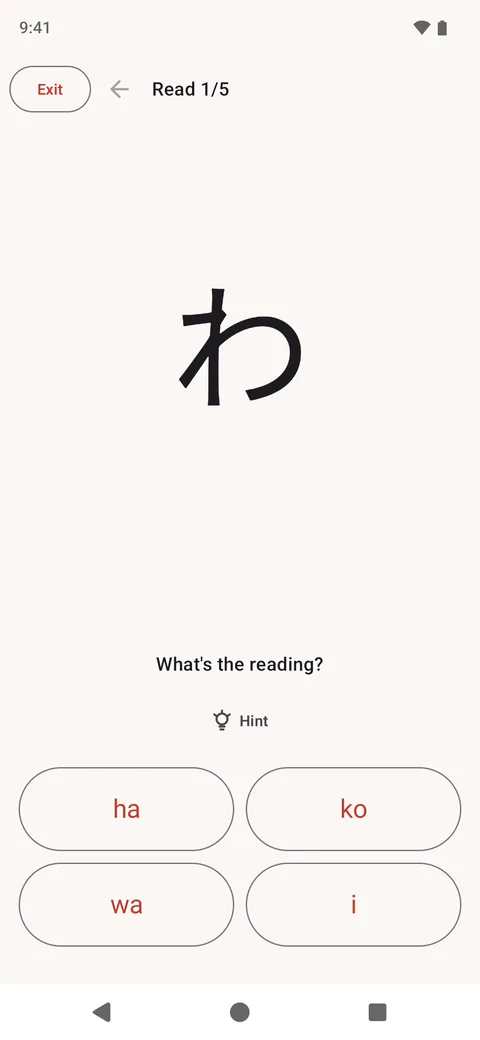
Hiragana, characterPick the reading for わ from four choices. 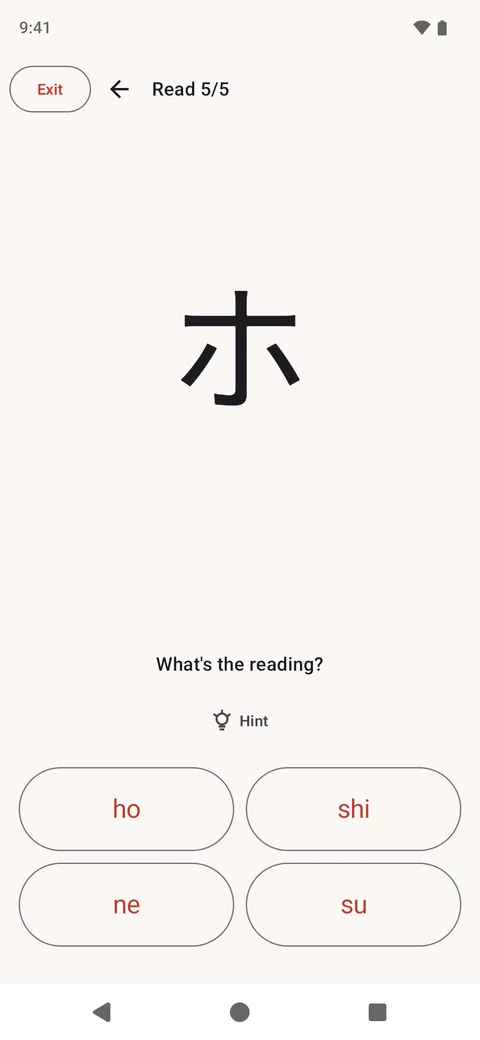
Katakana, characterThe same quiz for ホ. 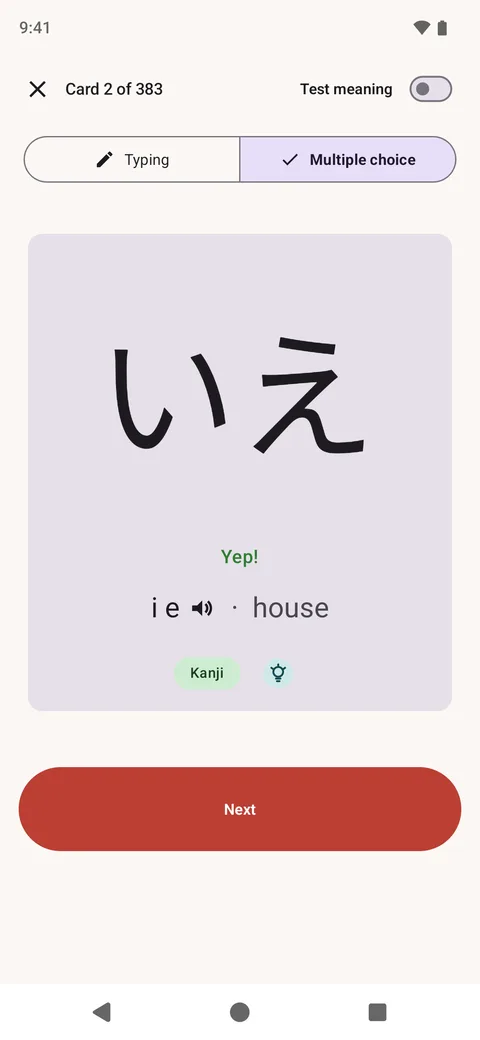
Hiragana, wordFlashcard for いえ, "house", with audio. 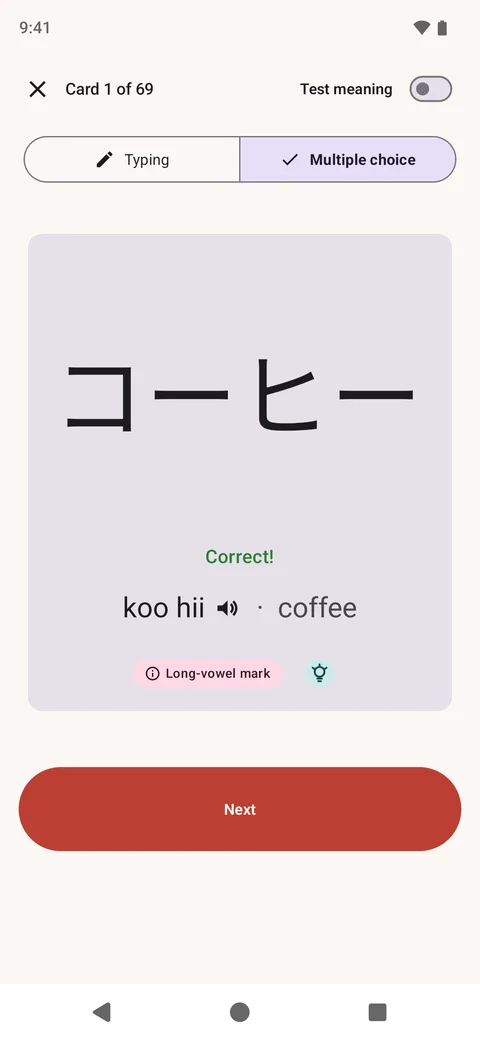
Katakana, wordFlashcard for コーヒー, "coffee", with a long-vowel note.
Writing
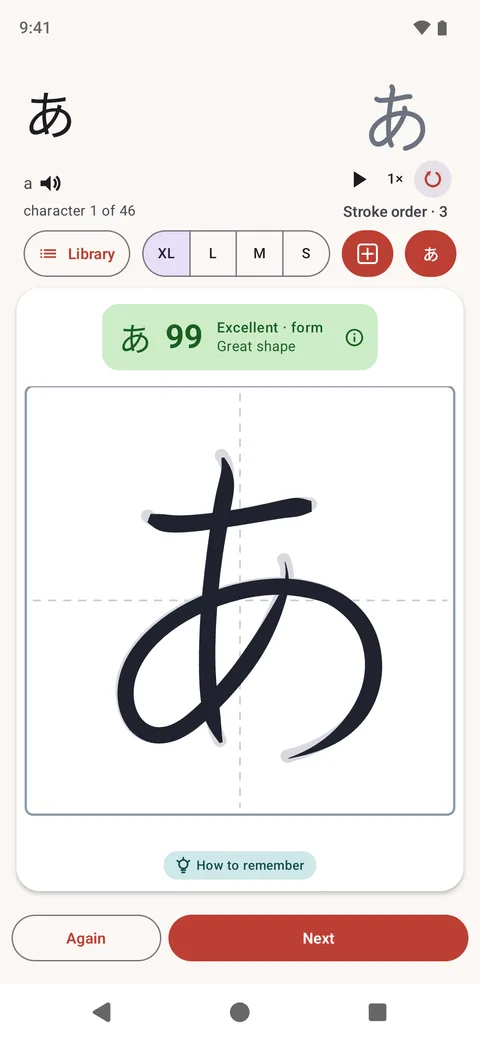
Hiragana, characterあ scores 99, "Excellent form". 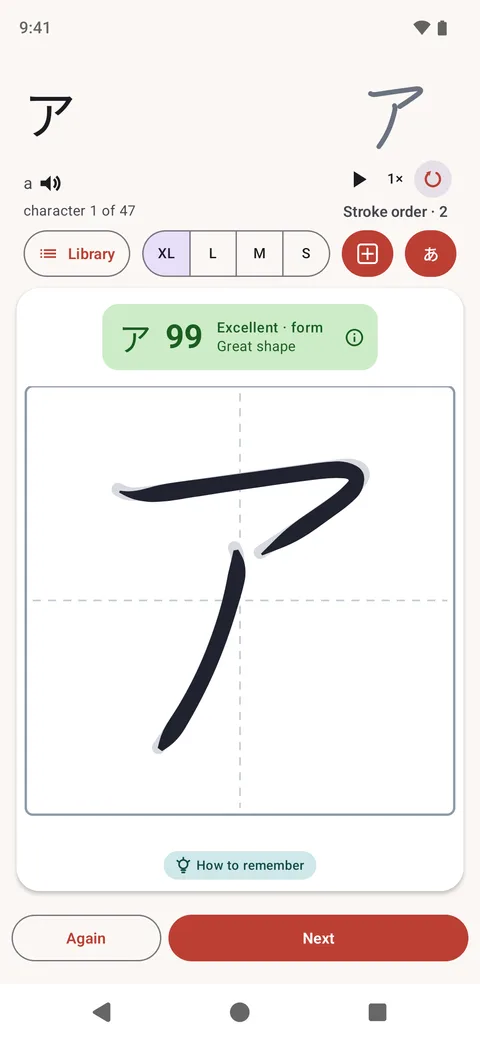
Katakana, characterア scores 99. 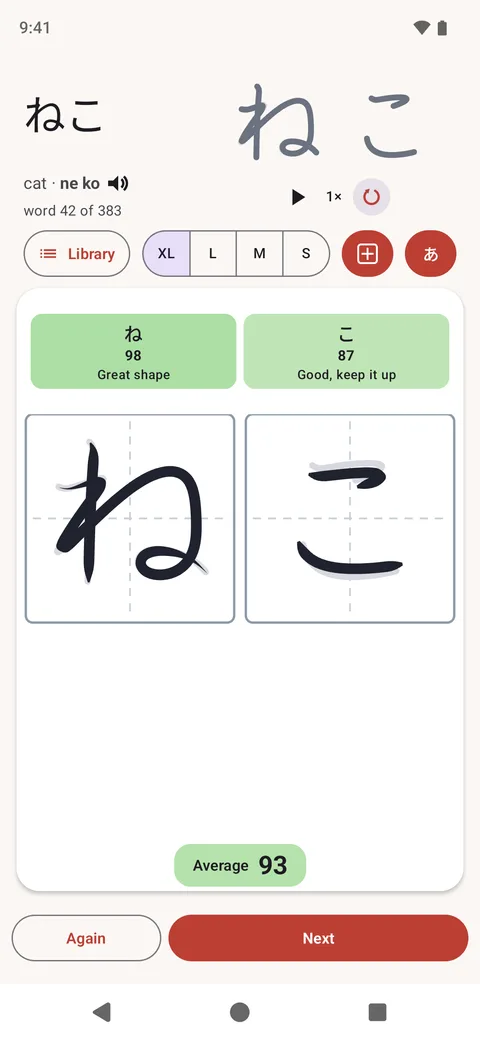
Hiragana, wordねこ gets 98 for ね and 87 for こ, an average of 93. 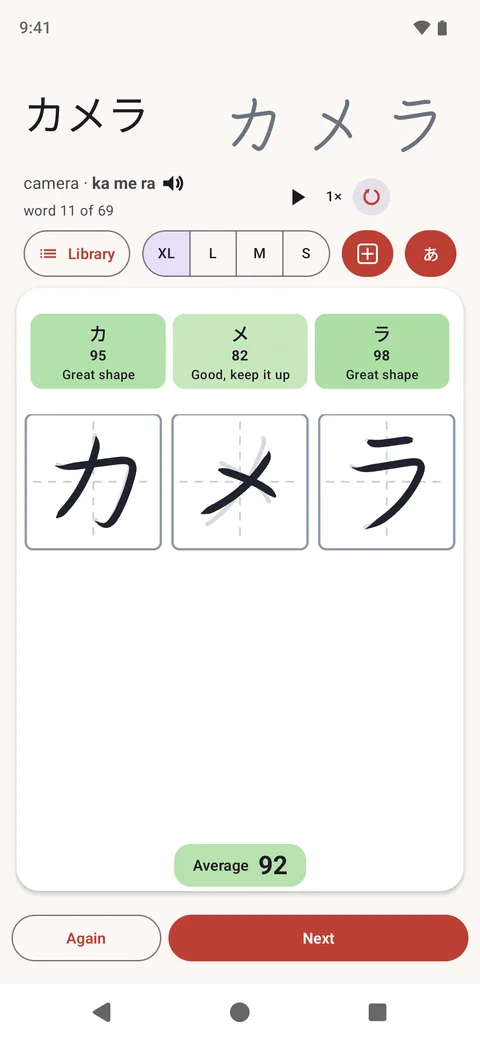
Katakana, wordカメラ gets 95, 82 and 98, an average of 92.
What it does
- Your handwriting gets a real score. Geometry checks plus ML Kit digital-ink recognition score what you actually drew, with no consolation floor. A calibration suite pins it: a clean trace scores 95 or more, a random line 12 or less.
- Trace the handwritten form, not the font. You write over a ghost of the kaisho (school handwriting) form on a genkouyoushi grid, by finger or stylus. The ink widens with pen pressure like a brush.
- Stroke order for every character. An animated demo draws each stroke with the recorded rhythm and pen lifts, with play, pause, replay and speed controls. Words get one demo per kana.
- Write from memory. Quiz me shows only the romaji and hides the guide. It works on whole words as well as single characters, and scores each kana in a word separately.
- A reading track for printed kana. Quizzes run in either direction, by multiple choice or by typing the romaji, plus flip flashcards with audio.
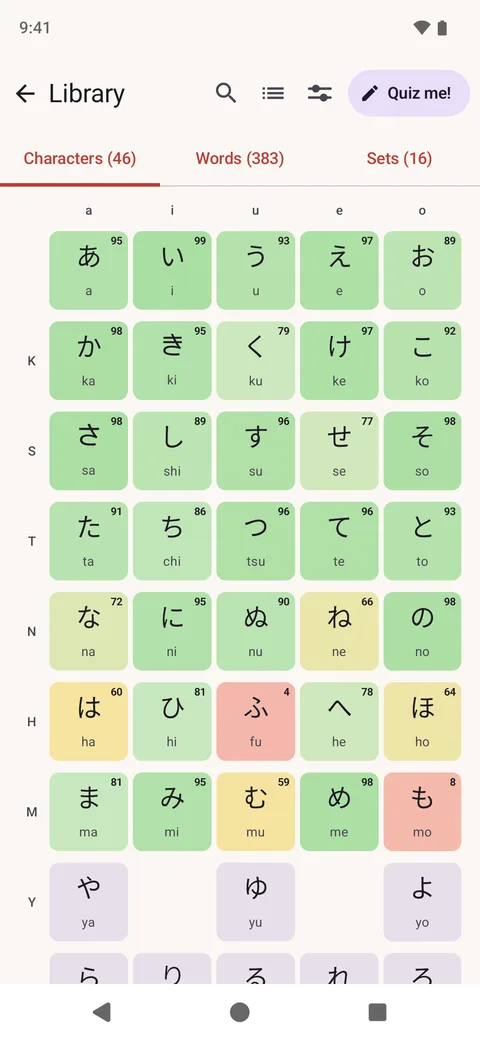
- See what still needs work. The library tints every character from red to green by your average score.
- Hear it, and remember it. A speaker button reads any kana or word aloud with the phone's Japanese voice. Each of the 46 basic hiragana has a memory story: あ is APPLE.
- All of hiragana and katakana. Voiced, combined and extended kana are opt-ins, so beginners start with the 46 basics and add the rest when ready.
How it was built
AI agents built the first version from three written phase prompts, starting on 3 July 2026. The first build session was lost before anything was written down, so the repo's HISTORY.md is a recovery record: what each phase asked for, what shipped and how every step was verified.
Decisions that mattered
- Cut a feature the day after it landed. Phase 3 added a spaced-repetition study mode with a scheduler, a lesson generator and a guided session. I removed it on 5 July and kept free practice and quizzes, with built-in practice sets for structure. Its tables stay in the database unused, because dropping them would take a destructive migration.
- Trace the font, animate the real strokes. The ghost you trace is drawn by the system font, which guarantees a correct shape. The stroke-order demo comes from KanjiVG's stroke paths, so both match real calligraphic proportions.
- Contracts before parallel work. Each phase started with a fixed design document and domain types, and then three or four workstreams built against it at once. Phase 3's four workstreams went green on the first integration build.
How it's tested
279 unit tests across 29 files. After Phase 2 and again after Phase 3, two independent review agents went through the code, and both rounds came back with no blocking defects. The live database migrations were checked on a real Pixel 7 running Android 16.
Where it stands
Version 0.4.0 is out as a downloadable APK, with all of hiragana and katakana, a reading track and 844 words.
Made with
- Kotlin
- Jetpack Compose
- Room
- ML Kit Digital Ink
- Gradle
Latest changes
Full changelog-
A real vocabulary, kanji reference, and honest scores
The word list grew from about 250 words to nearly 700. The hiragana deck now carries the common JLPT N5 vocabulary, plus 25 more katakana loanwords, so practising words no longer runs out of material.
-
Smarter Library search and visible scores
Your writing score now shows on each word in the Library list. Words in the Characters/Words list already tinted green by score; now they also print the number ("Avg 82 · Best 90", or "Not practiced yet"), matching the grid view and the character rows.
-
Quiz polish and memory hints for every kana
Memory hints now cover every kana, not just the basic hiragana. Katakana and the voiced, combined, and extended kana all get keyword-and-story hints, most with two or three alternate images to pick from. Composed kana (like きゃ or ヴァ) also show an always-on Structure note that spells out how the piece is built from its parts, separate from the memory hint itself.